Saturday, December 27, 2025

Warner Brothers Announces Surprise Merger!

  . 

 To follow unique Credit Union model!

Dateline - Los Angeles:  In a surprise move, Warner Brothers/HBO has announced plans to merge, rejecting competitive offers from Netflix and Paramount which valued the film studio at up to $108 billion dollars.

Warner's properties include: The Exorcist, Blazing Saddles, Lethal Weapon, Superman, The Matrix, Harry Potter, The Dukes of Hazzard, Murphy Brown, Friends, Roots, and Looney Tunes/Merrie Melodies. 

In a statement released Friday, a Warner Brothers spokesman said; "We recently discovered a different merger model - used only by credit unions - right here in California, which avoids all the difficulties of transferring the value of our company directly to our shareholders."  

"The new proposal eliminates any distribution of cash, while enabling our stockholders to become minority owners. Senior executives and board members will receive extended contracts, retention/change of control protection, and "retire-like-a-movie star" severance packages." 

"Further details will be released shortly, but that's all for now folks. If you have questions, please contact our investor relations department:  [direct link]  https://youtu.be/b9434BoGkNQ "

 It is rumored that the merger partner is a high-flying Washington State vulture capitalist.  

    Sure sounds just like my first cousin... Daffy!


Thursday, December 25, 2025

Credit Union Boards May Try To Tell Members To "Kiss Off", But...

   ... there is still hope!

Maybe it's just the spirit of the Season, or maybe it's that the persistent message of Christianity is one of mercy and hope. 

Every person - each of us - need a little help, a little hope, and somebody who believes in us.  That's the core wisdom behind every religion, same with credit unions...  when you take away hope, you break a heart.

This came to mind in reading  Ed Speed's "The CUDaily" opinion piece: "When the Temple Falls: The Collapse of the Credit Union ‘Movement’.  Mr. Speed is not only a great writer, but also a trained theologian. But hopefully he is preaching the wrong Testament - and there will be new hope!.

The Biblical story which may equally resonate, is of "the cleansing of the temple", when Jesus rebelled against the commercialization of the temple by expelling the merchants and the money changers, who profaned sacred, spiritual practices by doing so.

"The importance of the text is signaled by the fact that within a week of this incident, Jesus was dead. Matthew, Mark, and Luke agree that this  event functioned as the 'trigger' for Jesus' death." Not to mention that other little episode of insider betrayal and the notorious 'kiss-off" by a fellow named Judas Iscariot - for 30 pieces of silver. 

Hopefully the further commercialization of credit unions through profane mergers and on-the-take, self interest will not continue. Whether in religion or with credit unions, it is quite a sin that something so precious is forsaken - by greed - so cheaply.

  The "Spirit" [link] gives us new hope for a resurrection in values!

😎 ... even if the price of silver is at an all-time high and our "leaders" continue to wash their hands of all this!! Hope for the best!

  But watch carefully and duck, if your credit union board tries to kiss you...!

                     🎄🎄🎄🎄 MERRY CHRISTMAS! 


Wednesday, December 24, 2025

Credit Unions: Now That's The Spirit!

 ... A Wonderful Gift!

🎁🎁🎁 All credit union members in America have just received a wonderful gift for the holiday season!!


  -  "Members of Spirit Financial CU Reject Merger Into Credit Union 1" [link] 


😎 "It's A Wonderful Life!" [link: "Remember, every time a bell rings, an angel gets his wings"  Ring the bell, 'tis the Season!


 Ho, Ho, Ho...  Merry Christmas!!!! 


Sunday, December 21, 2025

Credit Union Members: Capital Punishment?


"Playing for keeps" with your money?

If you read the post, Credit Unions: A Capital Idea In Decline?, you noted that talking about credit union capital/reserves/equity can raise a lot of questions. Capital is an issue poorly understood by CU members, by most CU board members, and by many CU professionals. [Even "troll-twitterers" have a high propensity to go off half-crocked on capital!]

We want to get back to "The Godfather Mergers" series [link] because that's where most of the CU capital mayhem and shake-down is occurring. But, we have paused to discuss when a credit union has enough capital and how that is determined - using SECU as an example.

Credit unions are heavily regulated and insured by the federal government. As, you might suspect, federal law and regulation prescribe CU capital requirements - compliance is not optional!  Federal law requires a 7%+  capital/reserves ratio for a CU to be considered "well-capitalized" (the highest level). An excellent way to estimate this capital requirement is to simply multiply 7% times the total assets of the credit union. In the case of SECU, that would be 7% x $55 billion in assets = a $3.85 billion well-capitalized reserve requirement.

The second principal capital measure is a regulatory requirement that a CU keep capital/reserves greater than 10+% of "risk weighted assets". Not all assets of a CU - which are mostly loans and investments - have the same risk of loss for a CU. So each category of asset is assigned a potential "risk weighting". Some assets are weighted more, some less that that required 7% legal capital requirement. CUs running riskier operations are required to hold higher capital/reserves, which makes great common and financial sense. 

A CU must meet both measurements to be considered well-capitalized. The 7% "well-capitalized" capital/reserves requirement is a statutory (legal) requirement; the "risk-weighted" 10+% "well-capitalized" requirement is a much more refined analysis of actual risk exposure at a CU.

Look back at the post above [link]. You'll see that SECU over decades managed capital/reserves to that 7% level (within a 6% to 8% range). Well, what about the other "risk-weighted" capital ratio? Where was it? Did it fall below 10+% in 2008/2009?

😎  Just how risky is SECU? 

  As an SECU member-owner, what would you want?


Friday, December 19, 2025

Credit Unions: A Capital Idea In Decline?

 https://www.cryptopolitan.com/wp-content/uploads/2023/08/Prime-Trust-1.jpg  Poorly managed CU capital!

😎 Know casual readers are probably tired of talking about capital/reserves and want to move on, but bear with it one more round or two. Why?  Because those reserves/capital belong to you as a member-owner of your credit union. Is it being managed effectively, in your best interest? 

Anonymous December 18, 2025 at 5:02 PM [click to see full commentary]

"That's what you don't get. 7.01% is not a safe level, even if over the well-cap MINIMUM of 7%. How do I know that? Because in 2008 and 2009 you were unsuccessful keeping it above 7%. Explain how your statement that we've always been well-capitalized is not a lie. "

Our commenter is correctly "holding my feet to the capital fire"!  SECU did fall below 7% in 2008 and 2009 and under federal law was considered "adequately capitalized". What happened in 2008/2009 that caused the drop? What does the "plunge" (to 6.97%/6.83%) indicate about capital adequacy at SECU?

First, way back then, SECU managed its capital/reserves to a board-approved range of between 6% to 8%, with a target of 7%. SECU wanted to be well-capitalized (7%+). If the ratio fell below, it would be increased; and would be reduced, if it rose above 8%. That range reflected the well-analyzed and well-considered risk on the SECU balance sheet (potential loan losses, operational snafus and other similar facts of life!) 

Here's the SECU capital track record at year-end, per NCUA data -  prior to "new/new"

2003 - 7.34%; 2004 - 7.55%; 2005 - 7.55%; 2006 - 7.32%; 2007 - 7.24%; 2008 - 6.97%2009 - 6.83%; 2010 - 7.29%; 2011 - 7.43%; 2012 - 7.39%; 2013 - 7.32%; 2014 - 7.80%; 2015- 7.84%; 2016 - 7.75%; 2017 - 8.01%; 2018 - 8.43%; 2019 - 8.50%; 2020 - 7.95%; 2021 - 8.37%. (Pretty consistent !)

During this 18 year period, SECU grew from $11 billion in assets to $51 billion in assets, added @1.5 million members, grew every year, added 100+ branches, and never suffered a loss.

So your questions to consider: 

1) Was SECU appropriately and adequately capitalized during this period?

2) Why the crash in capital in 2008/2009? 

3) Was the board approved capital plan effective?

3) Why wouldn't an "industry standard" capital ratio of @11% be better?   

😎 Talk to you tomorrow...

  Risk comes from not knowing what you're doing - Warren Buffett 

Tuesday, December 16, 2025

Credit Unions: Now A Financial Mixed Metaphor?


✅ "A well-crafted metaphor uses consistent imagery ("hitting the nail on the head”). When you start mixing imagery ("hitting the nail on the nose"), you can create a type of malapropism known as a mixed metaphor."

The mixed metaphor thought came to mind in reading a follow-up story in CUToday [link] on the call, by the leadership at DCUC, for unity among credit unions [see Golden Rule/Retriever post]. “If we’re serious about unity, this is how we achieve it; it's one hour a quarter”

As you'll note, the Monday unity meeting drew scant interest, with fewer than 40 of the 180+ DCUC members "showing up". A poorly attended unity meeting smacks of mixed metaphor!  

Another classic was launched by DCUC chief lobbyist, Jason Stverak: "“When we’re doing the blocking and tackling on Capitol Hill, it’s critical that we’re rowing in the same direction.”  Blocking and tackling don't seem to logically mix with rowing; and rowing on a hill is also a bit of a stretch. 

DCUC CEO Hernandez clarified, "Complicating those efforts, are what he described as “muddy” factors... that affect how and when we can move (presumably rowing) forward (presumably uphill).”

✔ Credit unions used to be a "well-crafted metaphor" - a not-for-profit, member-owned and member-controlled cooperative, providing financial services to a limited group of individuals, particularly those of modest means.

😎  Hesitate to muddy the waters further, but the actual unity problem is simple: Credit unions are no longer in the same boat. 

Have credit unions become a malapropism, similar in look to the original definition...  but in practice, now a vacant vessel sailing down hill?

 Better lower the life boats and start rowing... it's an uphill climb! 


Friday, December 12, 2025

Credit Unions: "The Golden Rule" ?

As we enter the holiday season – with its focus on gratitude, kindness, and shared purpose – I’m struck by how these timeless values echo the founding principles of our credit union movement.  https://www.mygoldenretrieverpuppies.com/wp-content/uploads/2022/06/Golden-Retriever-Puppies.jpeg 

               Which One Is Golden? 

  Sometimes telling the truth is, well, telling the truth. Ed Speed lays it on the line in this CUDaily opinion piece [link]. 

😎 Are we going to the dogs?


   As the bankers would say, if it walks like a DCUC, talks like a DCUC, and acts like a DCUC;  then it probably is a...

Wednesday, December 10, 2025

Credit Unions: The Godfather Mergers - Part XII

 https://sayingimages.com/wp-content/uploads/one-does-not-simply-leave-the-family-godfather-meme.jpg .... or do they?

The SAFE CU Board of Directors has voted to merge with BECU, in effect giving away the Sacramento-based, member-owned credit union worth between $400 to $800 million [link] [link] .

✅ The California credit union regulator (DFPI) must approve the merger on behalf of 244,000 SAFE members, who primarily live in the State. Here's how the state regulator views its responsibility to SAFE members and the State of California:
 -------------------------------------------------------------------------------------------


"We believe that the combination of access, low fees, favorable state laws, and expertise and experience of the Department’s staff, make the state charter the charter of choice for California financial institutions 

Consumer protection is the foundation of DFPI’s mission, vision and purpose. In addition to regulation and rule enforcement, DFPI helps Californians by providing the tools and information to help them improve their financial outlook. This includes,..

  • A dedicated Consumers page, including resources to help people better understand their rights and make well-informed financial decisions, submit a complaint, verify licensed service providers, search enforcement records, and more. [link to more] "  

------------------------------------------------------------------------------------------------

 ✔ If the California DFPI endorses the merger, California will lose 1) a local, home-grown financial institution - owned by Californians, 2) export control of $400+ million in locally-owned capital - and the locally-focused economic development that capital supports - out  of state, 3) cede control of over $4+ billion in California consumer deposits to Washington State, and 4) essentially acknowledge that California DFPI does not, as it claims, offer "the state charter of choice for California credit unions". 

😎 Is encouraging and supporting the future expropriation of member-owned, credit union reserves for all California credit unions the definition of "consumer protection," - really?


  Do California Governor Newsome and his economic development folks agree with this downsizing of Sacramento?     

Sunday, December 7, 2025

Credit Unions: The Godfather Mergers - Part XI


“This is the business [the credit union] we’ve chosen.”  - V. Corleone

Hope you took a look yesterday at the following post [link] - explaining the current unseemliness of credit union mergers - for a couple of reasons: 

1) CU merger malpractice is widespread and has become predatory, 

2) the lack of effective regulatory oversight needs legislation,

3) or the clear breach of fiduciary duty by credit union boards and senior management requires litigation, 

4) And, as with our society... with credit unions , when anything goes everything goes. 

😎 A "Hobson's Choice"?:  Credit unions through mergers 1) are being mismanaged and misled or 2) are being sacked and looted? 

In our example merger between BECU/SAFE, it is indisputable that 1) SAFE CU is worth over $400+ million, 2) SAFE members can obtain the benefits of BECU membership for free by simply joining BECU (open membership), 3) the SAFE Board could easily and legally disburse over $400+ million to SAFE members and the merger would still be an exceptional purchase for BECU, 4) the merger proposal approved by the SAFE Board fails every test of economic, open market, business reasonableness, and 5) the current SAFE Board recommendation to the membership is financially deplorable - no if's, and's, or but's!

A couple of commenters have rightfully asked: "Was the potential sale of SAFE CU publicized, so that other credit unions could review and bid on the acquisition?If not, why not? How did the SAFE Board of Directors decide that BECU represented the best offer? 

If you were selling your home, would you list it publicly to seek the best price? Or as with this "sale", just give it away? Not seeking multiple bidders, nor the best price for SAFE shareholders fails the standards of "best practices", due diligence and fiduciary duty in the real world. 

Some commenters make the mistake of believing only a "larger" credit union could purchase the $4 billion SAFE - absolutely not true.  Even a $100 million CU could offer to merge with SAFE creating a $4.1 billion new CU. 

What the smaller, acquiring credit union might bring is a new energetic board with new ideas and a new vision on how to continue the growth of "the fastest growing CU in Sacramento" (according to BECU). 

 A different, more inspirational acquirer - small or large - could replace the existing board which is ready to throw in the towel, ready to sell out. Who wants to to work for a group which has given up? 

✔ And, perhaps the new acquirer could bring forth some "new creative blood" to replace the senior management who has already volunteered to step downand evidently, sees no benefit, no way forward as a local, independent California-focused institution. Why has the senior leadership given up on the existing staff and culture? What - or who - is actually the problem here requiring merger? 

California alone has 234 other local credit unions which might be interested in taking over SAFE and leading it forward. Some are larger, some are smaller. There are even two or three existing, Sacramento-based credit unions which have better operating expense and capital ratios than BECU! 

So, want to lower costs and truly enhance local service for SAFE member-owners ... think about the economies of scale and real service benefits of combining with other local, California credit unions! Why not seek answers locally, rather than take orders from Tukwila? 

😎 Probably not too difficult to find a few exciting, young CU leaders who would be willing to step up to this challenge, this wonderful opportunity...  in exchange for that $1+ million CEO pay package!  If you think no one is interested, try asking around... 

All California credit unions could offer a better financial deal to SAFE members than the merger currently approved by the SAFE Board 

  Don't believe that last statement, wanna bet?

** For the entire Godfather series click the "Godfather" button at top.


Friday, December 5, 2025

Credit Unions: The Godfather Mergers - Part X

 https://www.bimosyo.com/wp-content/uploads/2023/01/The-Godfather.jpg 

       "It's time to go to the mattresses." - M. Grant (?)

✅ The CEO of SAFE on the proposed merger with BECU [link]... interestingly in front of a vacant board table.

BNC Mag: "Asked if the merger will provide a specific financial benefit to SAFE members, spokesman Micah Grant said via e-mail, “We fully expect SAFE members to benefit with lower fees and loan rates, higher dividends on savings, and enhanced products and services.” [link]

Mergers of financial institutions often involve bonuses and extended employment contracts for executives of the selling concerns. Asked if the SAFE merger included such provisions, Grant said, “Our standard policy is not to discuss confidential personnel information.” 

✅ SAFE Board members are not compensated, BECU Board members are compensated [link]. Apparently, at least two SAFE board members have agreed to join the BECU board. 

✅ According to the SAFE CEO:  "I will continue to lead our region as the Market President for the Greater Sacramento region reporting to Beverly Anderson, BECU's President and CEO." [see link above] 

The non-profit monitor, Candid (formerly "Guidestar"), provides full, state-chartered credit union financial disclosures. Here's the SAFE "IRS Form 990" [link]. Will the SAFE CEO retain the $1.2+ million compensation package and for what guaranteed period, in the new, lesser role? The BECU "IRS Form 990" can be found here [link].

✅  Clearly there is a lot of money up for grabs in this merger proposal... particularly the $400+ million in cash owned by the 244,000 member shareholders of SAFE.

 😎 Maybe a couple of members should ask Micah Grant [From SAFE website:"please email mediainquiry@safecu.org or call VP Communications and Public Relations Micah Grant at 323-868-9067": "Who is looking after those members' best interests?"

  Credit Union mergers: "This is not your father's Oldsmobile", is it!

** For the entire Godfather series click the "Godfather" button at top.


Wednesday, December 3, 2025

Credit Unions: The Godfather Mergers - Part IX

  “I have learned more in the streets than in any classroom.” - V. Corleone ** 

You learned in Part VII [link] what you already knew, successful businesses sell for a premium over book value.  That's just common sense, basic economics, sound business practice - except with credit unions! 

  "Can’t wait for you to explain why BECU [a current, proposed merger] would accept something that you can’t show has ever happened." 

Have you paid attention to the growing number of recent purchases of banks by credit unions nationwide? Here take a look at some articles [link] or here's a list [link]. Here is an interesting fact about those purchases:

"The premium required to undertake the transaction might not make economic sense. For example, a credit union cannot legally purchase bank stock in most instances. It must purchase the assets and assume the liabilities of the bank, which is then liquidated.  The consideration must be paid in cash ... All other things being equal, a credit union purchasing assets and assuming liabilities must be willing to pay more for the target institution than would a bank to offset the tax liabilities and additional legal costs." [link]

Just in case you might miss the point. Trolls try to claim no credit union [BECU in this example] would take on another credit union, if the reserves/equity was fairly paid out to the [SAFE] member-shareholders. Clearly not true, a bit silly, just more troll trash... here's why.  

When a credit union buys a bank, it pays a premium (much more) than book value for the bank.  The credit union pays out to the bank shareholders the book value (equity/reserves/capital) plus the premium in cash! 

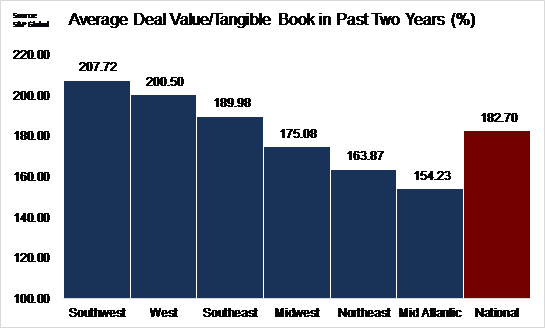
To give you an idea of the premium price being paid for banks, take a look at this graph:

Average Deal Value/Tangible Book in Past Two Years (%) 

* As you'll, note the premium paid nationwide has been 182.70% (1.8X) of book value, in the west coast market the premium was 200.50% (2X) book value. [link]

✅ If you can acquire a bank and pay out the equity in cash to bank stockholders, why would you try to screw the loyal member-owners of a credit union [SAFE] out of their legally owned equity? 

😎 Why is the Board of Directors of SAFE CU giving away a business owned by its' member-shareholders and clearly worth between $400 million (1X) and $800 million (2X)? 

 Because those 244,000 folks in California are all rich, they don't need it?

** For the entire Godfather series click the "Godfather" button at top. 


Tuesday, December 2, 2025

Credit Unions: The Godfather Mergers - Part VIII


"We’re both part of the same hypocrisy.” – M. Corleone 

  "We were promised to be enlightened as to why BECU would accept the merger. That isn’t in here! [link Part VII] How come? Couldn’t come up with a single reason?" 

Our troll seems to be on the verge of dampening his britches!  Being all wet in these discussions is unhelpful, so lets proceed with the valuation of a credit union as a business. 

We saw in Part VII that SAFE CU [being used only as an example] has a net worth of @ $400 million. Those reserves legally belong to the 244,000 member-shareholders of SAFE. The 11 member Board of SAFE has decided to give that $400 million in cash away for no apparent good reason - instead of disbursing the $400 million to each SAFE member. Remember, any member of SAFE who would like to join BECU can do so today for free! [ at BECUMembership is free! - link]. 

But to help our troll stay dry, here's why BECU should still jump at the merger, even after the $400 million in cash is distributed to the rightful owners - 244,000 SAFE member-shareholders.  

✅ First, there is again no dispute that BECU would still receive a thriving $4 billion asset business, 244,000 additional members, 21 branches in 13 cities, a knowledgeable, experienced, local staff, with a strong reputation for service. What's that worth?

✅ Second, BECU will be acquiring: " SAFE Credit Union is one of the fastest growing credit unions in the Sacramento, California area." -according to Caitlin Goettler, BECU Public Relations Manager 

Third, successful, "fastest growing" businesses generally sell for a premium well in excess of their "book value". We're confident that the book value of SAFE is @$400 million [see link for calc.]. The premium paid by an acquirer for a financial institution can vary by location, clientele, product line, reputation and  track record; but the premium paid is generally between 150% (1.5X) to 200% (2X) of book value ($400 million)!  

That would mean the approximate market value of SAFE Credit Union is between $600 million and $800 million in today's marketplace. 

Said another way, even after fairly distributing the $400 million in reserves to existing SAFE members; the acquiring institution [BECU in this example] would still be receiving a free, thriving, credit union worth $200 to $400 million!

You can be certain that BECU with the help of Jefferies, LLC understands the value of SAFE Credit Union...

😎 It appears clear that the SAFE CU Board does not...

  "A lawyer with a briefcase can steal more than a hundred men with guns."  - Don Vito Corleone

** For the entire Godfather series click the "Godfather" button at top. 


Monday, December 1, 2025

Credit Unions: The Godfather Mergers -Part VII

 Iconic cover photo featuring Marlon Brando as Don Vito Corleone from The Godfather movie, looking thoughtfully with his index finger up. The cover includes "The Godfather" article. 

   "I know it’s wrong, but I don’t care.” - M. Corleone **

 "Where can you find an acquiring credit union, which will take another one on with no capital?"


Forget those ideals of cooperative principles, "people helping people", local member-ownership and control; our troll is obviously clueless about the core economic worth of a credit union.  Unfortunately, credit union boards also appear to be deeply in the dark. At least one hopes it's ignorance, not cupidity. 


Everyone selling a business seeks to determine "what it is worth", a fair price, a fair value. An owner wants best value, folks like the IRS want their share too.


Valuation of a credit union as a business is straightforward, since the assets and liabilities are pretty uniform (loans, investments, some buildings and equipment, member deposits, and reserves). 


Credit unions are also heavily scrutinized by both regulators and CPAs to assure that financial statements reflect a fair representation of the approximate value of each holding. Both loans and investments are regularly adjusted to reflect potential losses in value. If everyone is doing their job, when looking at a credit union balance sheet; for the most part, "what you see is what you get" in terms of "book value" of the institution.  


The formula for the "book value" of SAFE CU - if the Board were selling it rather than giving it away - is Assets (loans, investments, buildings, etc) minus Liabilities (member deposits, CDs, IRAs, etc) equals Equity (also referred to as book value, net worth, reserves, or capital).  A-L=E!


For SAFE that would be (A) $4.4 billion in loans/investments minus (L) $4 billion in member deposits = (E) $400 million in equity/reserves which is owned by SAFE members - and available for distribution (@%1,639 per member).


😎 ' Course that only applies if the SAFE CU Board chose to sell the credit union, not give the members' equity/reserves away. 

 Last time I checked, credit unions were classified as not-for-profits, not charities... $400 million is a large gift of other people's money! 


** For the entire Godfather series click the "Godfather" button at top.